Prof. Ong Wee Jun and Team Publish in Journal of Materials Chemistry A
Published on October 20, 2026
The Research and Postgraduate Centre congratulate PhD candidates Brenden Jing Su, Elton Song-Zhe Mah, Naufal Arshad, and Prof. Dr. Ong Wee Jun from the School of Energy and Chemical Engineering and the Center of Excellence for NaNo Energy & Catalysis Technology (CONNECT) on their recent publication of a research article in Journal of Materials Chemistry A, a SCIE Q1 journal with the latest Impact Factor of 9.2.
The article is first-authored by PhD student Brenden Jing Su and co-authored by Elton Song-Zhe Mah and Naufal Arshad, under the supervision of Prof. Ong Wee Jun. The research also includes collaborative contributions from Prof. Xianhai Zeng of Xiamen University and Dr. Lling-Lling Tan of Monash University Malaysia.
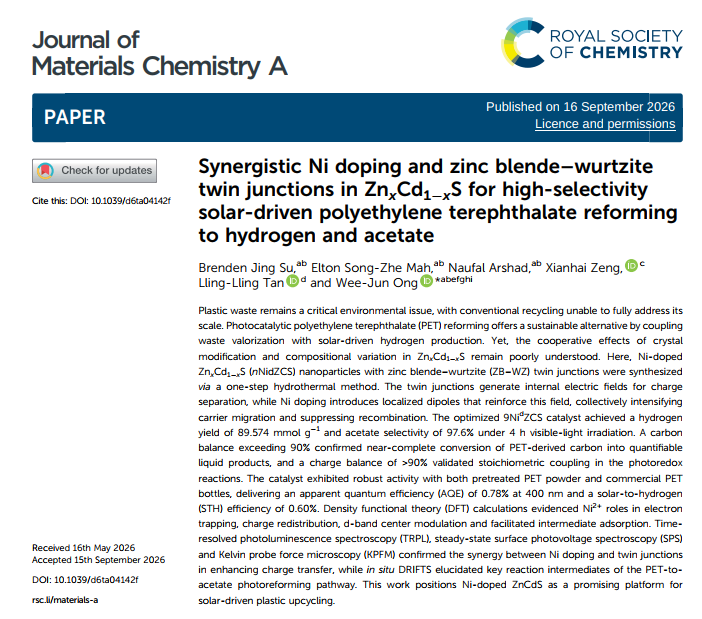
The article, entitled "Synergistic Ni Doping and Zinc Blende-Wurtzite Twin Junctions in ZnxCd1-xS for High-Selectivity Solar-Driven Polyethylene Terephthalate Reforming to Hydrogen and Acetate", presents advanced work on a Ni-doped ZnCdS photocatalyst engineered with zinc blende-wurtzite twin junctions, aiming for high-selectivity solar-driven conversion of polyethylene terephthalate (PET) plastic waste into hydrogen and acetate. The optimized Ni-doped ZnxCd1-xS nanoparticles with Zinc Blende-Wurtzite twin junctions (9NidZCS), synthesized via one-step hydrothermal synthesis, delivers a hydrogen yield of 89.574 mmol g-1 and 97.6% acetate selectivity within 4 hours under visible light. The system performs robustly on both pretreated PET powder and commercial bottles, establishing Ni-doped ZnCdS as a viable platform for solar-driven plastic upcycling. This work positions Ni-doped ZnCdS as a promising platform for solar-driven plastic upcycling.
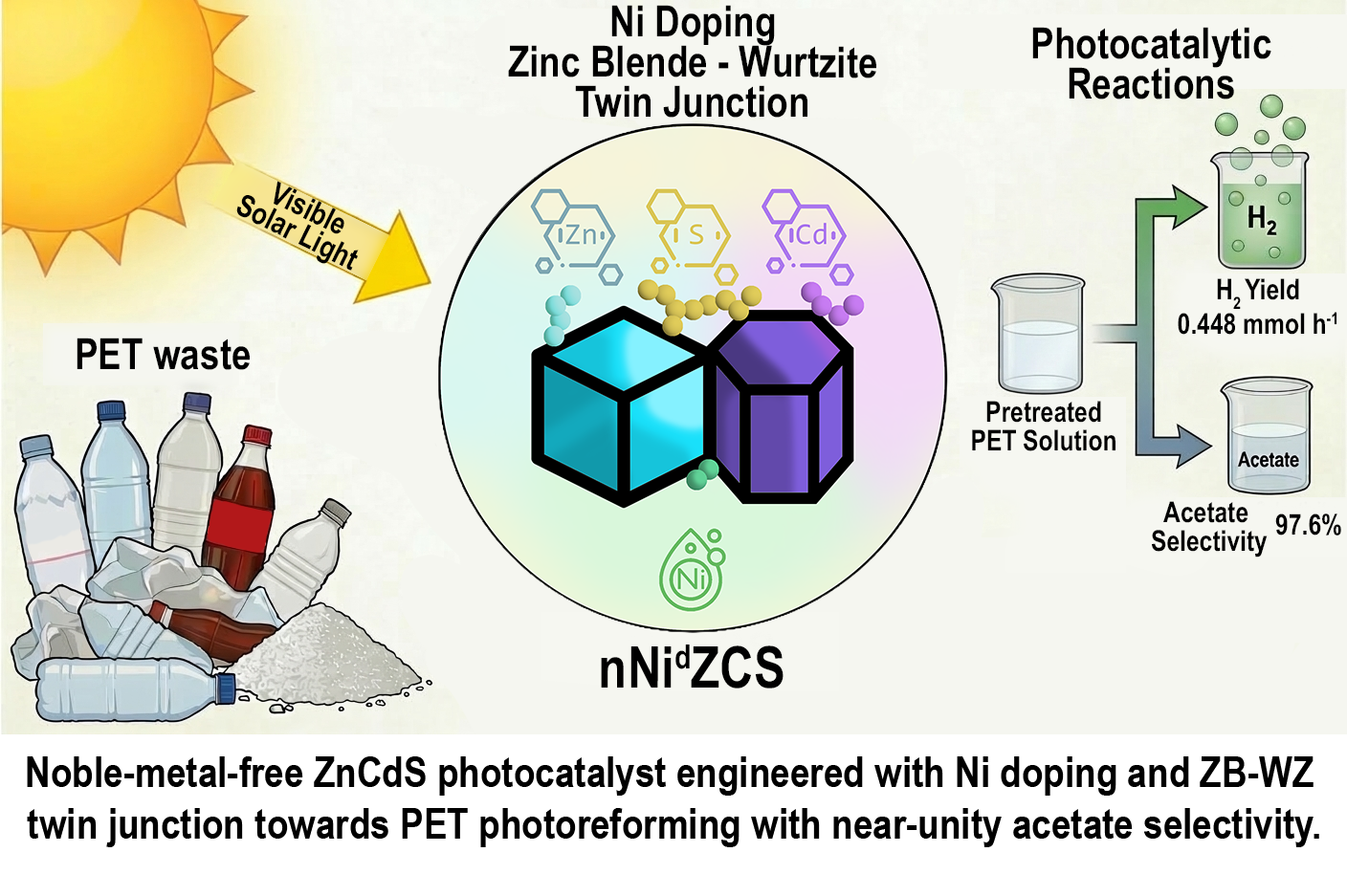
Graphical abstract of the work published.
The full article is available at: https://doi.org/10.1039/D6TA04142F
This research project received funding support from the Ministry of Higher Education under the Fundamental Research Grant Scheme (FRGS); the PETRONAS-Academia Collaboration Dialogue grant from PETRONAS Research Sdn. Bhd. (PRSB); the Ministry of Science, Technology and Innovation (MOSTI) Malaysia under the Strategic Research Fund (SRF); Agilent Technologies Malaysia Sdn. Bhd. for their contribution through chromatography; the National Natural Science Foundation of China and Guangdong Basic and Applied Basic Research Foundation; the State Key Laboratory of Physical Chemistry of Solid Surfaces, Xiamen University; the Embassy of the People's Republic of China in Malaysia; the Ministry of Education of the People's Republic of China. Additional support was provided by the Xiamen University Malaysia Investigatorship Grant and Xiamen University Malaysia Research Fund.
Prof. Ong Wee Jun is the Assistant Dean of School of Energy and Chemical Engineering and the director of CONNECT research center at Xiamen University Malaysia. His research interests include nanomaterials for photo(electro)catalytic and electrochemical H2O splitting, CO2 reduction, H2O2 synthesis, nitrate-to-ammonia, alcohol oxidation and organic synthesis as well as microwave plasma methane cracking for graphene and hydrogen production.
For more details, refer to his website: https://sites.google.com/site/wjongresearch/